17 September 2026
Directing of Things / The Interior TheaterThe Long Escape to Cadaqués, or Surrealism at Home
The Long Escape to Cadaqués, or Surrealism at Home
For most people, an interior and the objects in it are just silent extras in the frame of a pretty picture. But in this Home, objects have an official right to their own personal space, and even to a life of their own, hidden from outsiders’ eyes.
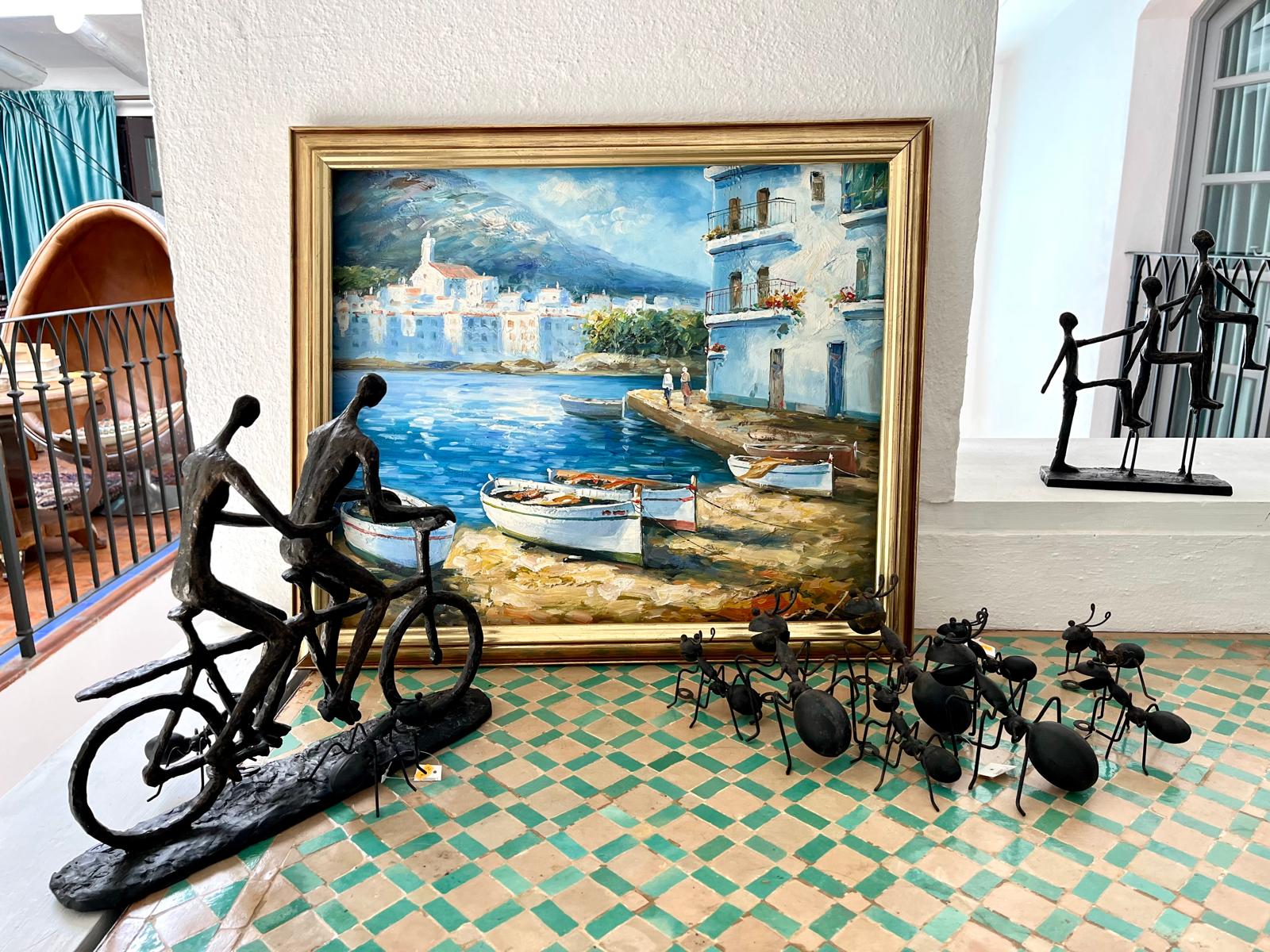
A funny, very telling example of this kind of independence is a scene that’s unfolding right now on the terracotta floor by the white wall.
🖼️ Act I. Rebellion on the Wall Panel
It all started with an Important Painting. It depicts Cadaqués — a cult, cliff-hidden fishing town at the very northern tip of Spanish Catalonia, right on the border with France. It’s a sacred place of power for Mum on this earth, over which the snow-white Santa Maria church rises majestically on the canvas.
The story of how the painting was found is remarkable: it’s devoted to Cadaqués, but it was found on the other end of the earth — Dad literally rescued this treasure of Mum’s, spotting it in the dust of a provincial brocante.
For a long time, the painting occupied its strictly designated spot on the wall panel above the stairs. It hung where Mum and the rest of the household could see it several times a day, and the sun would drop in through the window for exactly half an hour to warm the canvas with its rays.
But one day, the painting… just fell down. The frame, fortunately, wasn’t damaged. Dad honestly tried to return the runaway to its rightful place, but the renovation gods decreed otherwise: the canvas was temporarily leaned against the wall by the floor. As we all know, though, there’s nothing more permanent than something temporary.
🚴♂️ Act II. Fellow Travelers
A little later, new actors spontaneously appeared at the foot of the canvas — an expressive metal sculpture of cyclists. The scene’s vibe changed instantly: it looked as though the two of them were pedaling across the terracotta tiles straight into the frame itself — toward the sea, the white houses, and the sun-drenched streets of Cadaqués. It became very charming and dynamic.
🐜 Act III. Salvador Dalí’s Great Comeback
But a few days ago, after the existential creative chaos that Dolce the monkey stirred up, the set design took a sharp turn in character. The iron ants that had taken part in that wild photo shoot were left, by Mum’s own hand, right there — directly in front of the painting.
And that’s when a fantastical loop of space and time closed, revealing the Home’s true directing hand. As it turns out, these ants had been brought back from yet another pilgrimage… to that very same Cadaqués! A whole colony arrived from that trip: some of them had long since settled into the interior, while this group had been sitting in a box, waiting for their moment.
Cadaqués is Salvador Dalí’s native land, the place that shaped his genius. And ants were the central, recurring symbol in his work, representing the mad rush of life and the transformation of time. Years later, three absolute coincidences met on the floor by the stairs: a painting rescued from the dust of a brocante, Dalí’s ants arriving from its hometown, and cyclists storming the horizon. What’s more, it’s precisely in Cadaqués, of all places, that the largest real-life ants Mum has ever seen happen to live.
Is this an open-air gallery, where travelers and insects have frozen in admiration before a work of art, or do they come alive under the evening sun and head off home together, back through the canvas’s frame? That’s for the viewer to decide. But one thing is obvious: this performance was directed by the very spirit of Cadaqués itself.