21 September 2026
Secrets of Hallmarks and TimeThe Anatomy of Time: A Short Guide to Conserving Antique Grandfather Clocks
The Anatomy of Time: A Short Guide to Conserving Antique Grandfather Clocks
If you’ve ever acquired, or rescued from a flea market, a pendulum floor clock a hundred, two hundred, or three hundred years old, what you’re holding isn’t just a piece of furniture. You’re holding a self-contained ecosystem of time. Giants like this were built from centuries-old oak, walnut, or mahogany and forged metal, engineered to survive across generations. But long years of neglect, damp, or improper storage leave heavy scars.
Before picking up any tools, every collector needs to learn the basic code of gentle, analog rescue. One wrong move can instantly destroy what the centuries themselves spared.
🧹 Stage 1: Total Dry Cleaning — the Law of First Touch
Any attempt to immediately wipe down or wash a century-old antique turns historical dust into abrasive grit that will lodge permanently in the wood’s pores and scratch the old patina. The first touch a clock receives must be strictly dry.
- Natural brushes: Cleaning the wooden case and its hidden cavities begins with dry painter’s or artist’s brushes with natural bristles of medium stiffness. Soft brushes are reserved for delicate zones.
- Attention to carved detail: Baroque scrollwork, rocaille, and recesses demand jeweler’s patience. All the centuries of dust, cobwebs, and insect cocoons are gently swept out of the relief.
- Wooden tools only: For ingrained, compacted dirt in small details and joints, metal scrapers or knives are categorically forbidden — they’ll leave irreversible scratches on the oak. Only soft wooden spatulas, bamboo sticks, and ordinary toothpicks are allowed.
- The jeweler’s rule of the vacuum: When cleaning the movement and interior corners, the vacuum cleaner is set to minimum power, and a nylon stocking is always stretched over its nozzle. Antique clocks conceal tiny parts lost to time — brass stop pins, washers, small springs. The nylon saves these priceless fragments of history from being sucked away forever.
🛑 No-Go Zone: Metal, Brass, and Removing the “Brains”
While the case is being cleaned, the clock’s “brains” — the dial and movement — must be fully isolated from any outside interference and taken out of the case.
- Removing the “head”: On the vast majority of floor clocks from this era, the upper part of the case (the hood, or “head”) is removable. It either slides forward smoothly along grooves, or lifts straight up and off, opening full access to the movement.
- Extracting it from the runners: The brass movement, together with its heavy dial, was never bolted permanently to the clock. It’s fixed to a horizontal wooden board (the seat board), which simply rests on vertical grooves — runners — inside the case. Removing it takes jeweler’s care: gently lift the seat board and smoothly slide the whole assembly, dial included, forward. From this moment on, the “brains” live separately, on a dry shelf.
- Dials: Antique brass was coated with an extremely thin protective layer of original lacquer or noble patina, and the engraved numerals were filled with a special mastic. No moisture, no aggressive household chemicals. Dry brushes only.
- The movement: The chief enemy of steel arbors, pinions, and gears is rust. A single microdrop trapped between teeth can jam the wheel train forever. Dust removal here is strictly dry.
🐛 Stage 2: Fighting Pests and Preventive Fumigation
Antique wood almost always carries traces of woodworm. Even if the tunnels look old and there’s no fresh sawdust, preventive treatment is mandatory before bringing the clock into a lived-in home.
- Chemicals before wax: Professional insecticides based on modern permethrins must be applied strictly before the final wax coat — otherwise the wax film blocks the treatment from soaking in. The solution is injected with a syringe into every old hole and applied generously by brush to unpainted interior surfaces.
- The restorer’s international arsenal: In Spain and Portugal, the gold standard is Xylazel Carcomas; in Germany, Wood Bliss or Remmers; in the UK and France, Liberon or Polyvine.
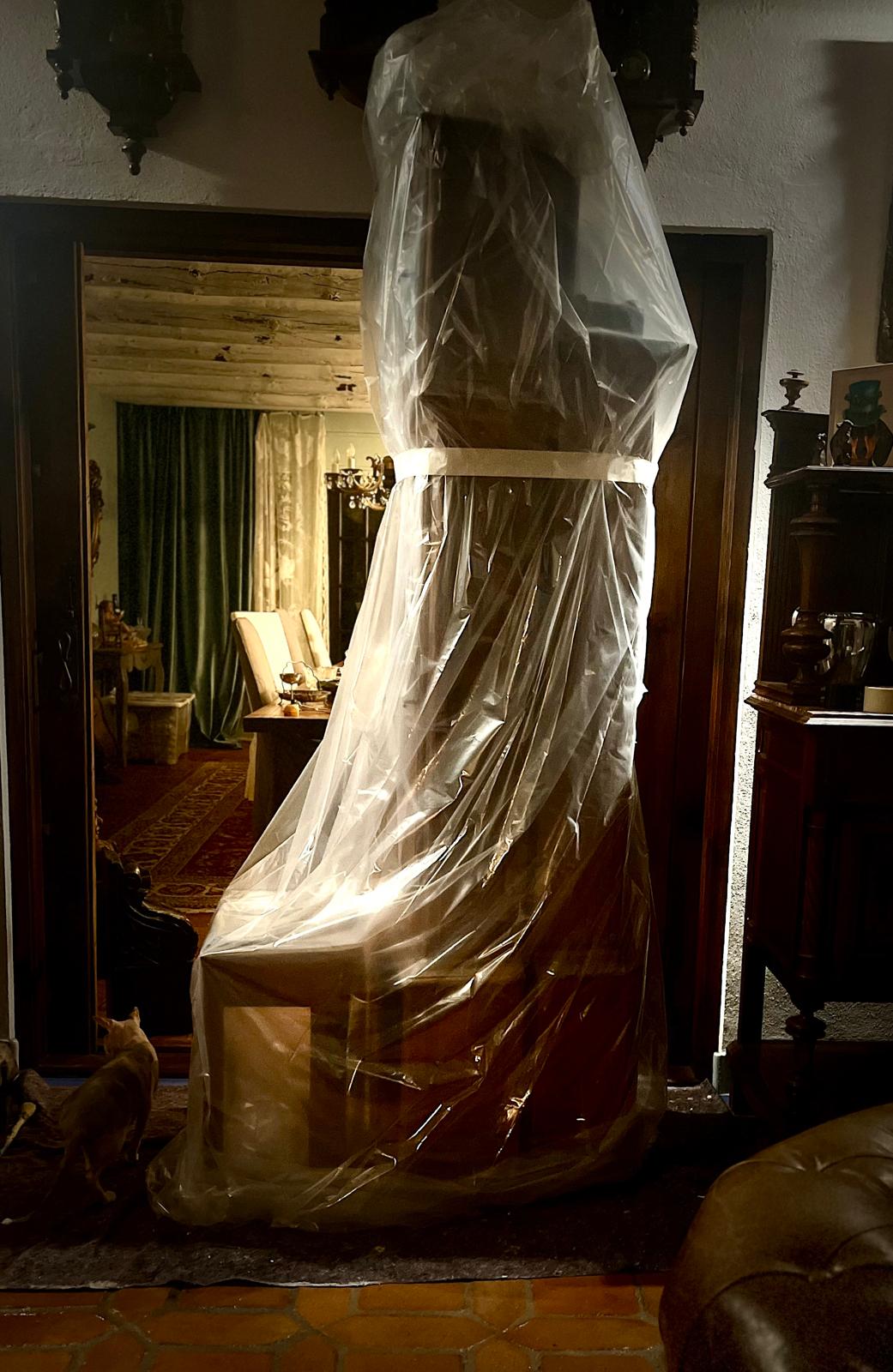
- The “Spacesuit” Method (Cocooning): To let the solvent’s vapors penetrate the tunnels to their full depth, the case is sealed airtight inside heavy-duty construction-grade cellophane. Seams are fixed with painter’s tape. The clock is left in this suspended state for 48 hours. This reliably traps the sharp smell and guarantees complete eradication of woodworm and cellar spiders alike.
📜 Archives Written on Wood: Hidden Markings
A floor clock is a living diary. Examining the empty wooden case from the inside, a collector should look for hidden inscriptions on the back panel, the doors, or the “roof” of the hood. Chalk, wax marker, and old iron-gall ink on fragile rag paper must never be wetted. After a dry brush cleaning, they’re preserved either with a matte artist’s spray lacquer or by gently “working in” warm natural wax.
🫧 Stage 3: Delicate Cleaning of the Wooden Case (At Your Own Discretion)
Once fumigation is complete, the final stage of care for the case begins. Classical museum-standard restoration is famously terrified of water, so any wet procedures are carried out strictly at your own discretion and your own risk. Distilled or neutralized water may be used (with a drop of fabric softener to balance the pH). The solution is applied to a microfiber cloth until barely damp, a section is wiped locally, and it is dried immediately. At the end, the wood is finished with natural wax.
⚠️ Physics, Logic, and Safety When Moving the Clock
- No forcing: If years of outdoor storage have warped the shelves or back panel from humidity, never try to force them back into place. Once the wood dries out in a warm room, the parts will settle back into their grooves easily, with a minimal, controlled tap through a wooden block.
- Protect the old glass: The glazing on antique clocks is its own fragile treasure. Glass from that era was hand-cast — thin, uneven, with distinctive ripples, air bubbles, and an inimitable “waviness.” If a pane like this breaks, finding an authentic replacement in today’s world of flat, factory-smooth glass is nearly impossible.
- The door trick: Before tilting, moving, or laying down the case, always close and secure every door firmly (with painter’s tape or string). If a heavy oak door with old, wavy glass swings open under its own weight while the case is being tilted, the hinges can be torn out at the root, and the fragile historic glass is guaranteed to shatter.
- If the clock must be laid down: If circumstances require laying the case flat on the floor, this may only be done after the “head” and “brains” have been fully removed. A clock is never laid directly on bare tile or parquet. Heavy geotextile or felt is spread on the floor first, and a soft platform of rolled blankets or sofa cushions is built up under the clock’s “shoulders,” so the protruding wooden cornice decoration never bears the weight of the whole oak giant. Any lifting and tilting is always done by two people.