15 October 2026
Secrets of Hallmarks and TimePart 4. The Geometry of Deception and Hidden Axes: Solving the Tilted Cornice and the Pin Hinges of the Paulissen 1774
Part 4. The Geometry of Deception and Hidden Axes: Solving the Tilted Cornice and the Pin Hinges of the Paulissen 1774
Once the large-scale conservation work — stabilizing the roof’s paper shell and seating the fragile blown glass onto its cushioning pads — had been moved into a phase of natural, day-by-day stabilization, the Covent Garden Syndrome restoration yard ran into a fresh set of structural anomalies. A close look at the hood’s bared wooden frame turned up two hidden engineering facts that sent us straight back to the materials-science war room, right there at the four-meter table.
Below is a detailed breakdown of the optical and joinery puzzles of this 250-year-old hood — proof, once again, of the thoroughly handmade and deeply deliberate nature of this monumental Liège aristocrat.
We still make no claim to academic expertise — only to sharing hands-on experience, step-by-step methods, and the small secrets of materials science.
Chapter 1. The mystery of the “falling” cornice: the laws of Baroque perspective
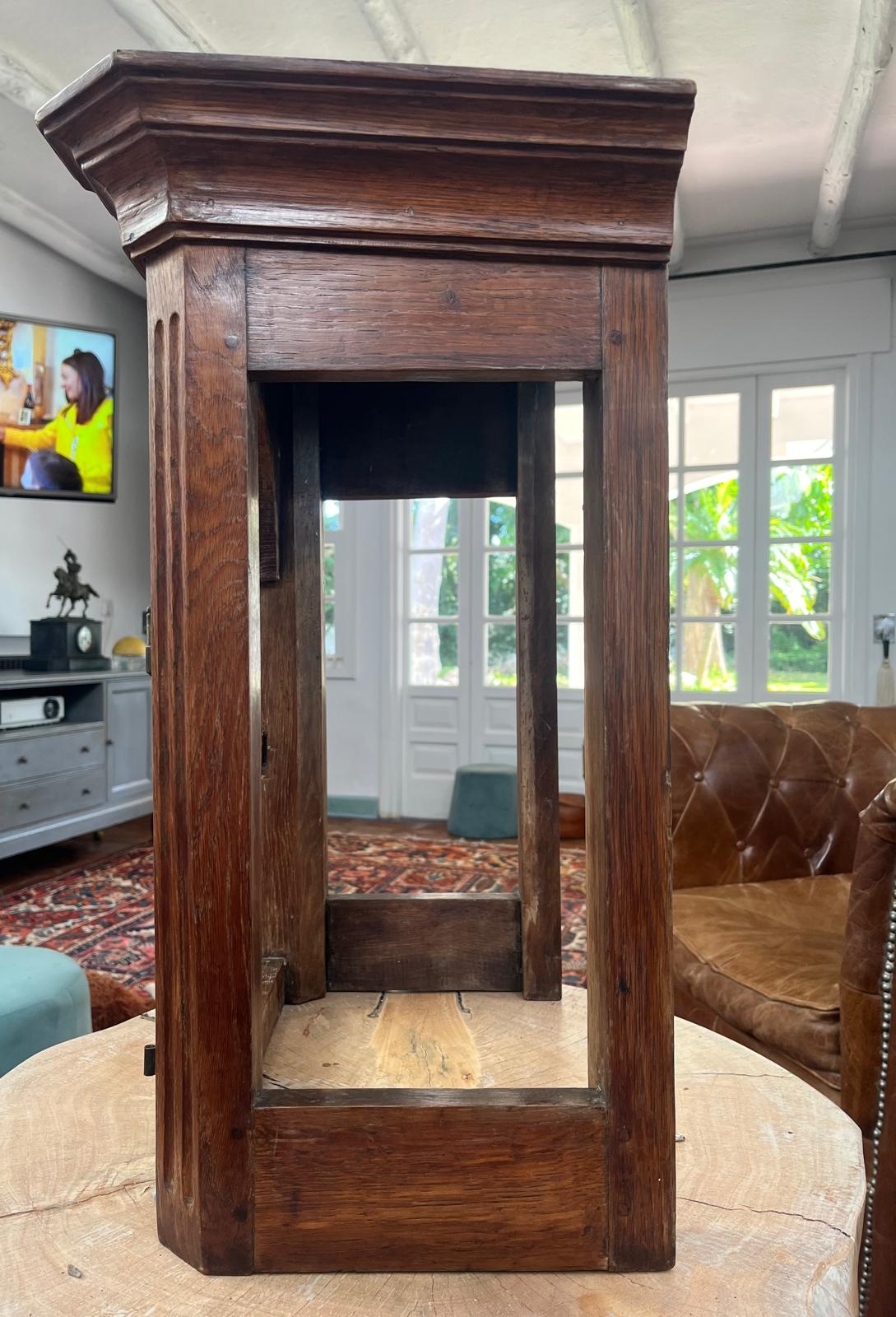
Lining up the black-walnut hood’s horizontal edges against the strict geometry of the workshop’s modern ceiling beams exposed a jarring visual mismatch. The hood’s profiled front cornice (the crowning molding of the hood’s roof) slopes down at a clear, aggressive angle. The first natural hypothesis pointed to destructive radial warping of the solid wood, or a critical skew in boards shrunk over two centuries.
Instrumental checks of the hood’s internal geometry ruled that out: the hood’s own ceiling plane (its inner roof base) remains perfectly flat and level.
A detailed look into the laws of Baroque architecture, worked through together with Gemini, uncovered the true, deeply carpentry-rooted explanation:
- Optical angle correction (the illusion of grandeur): The Paulissen grandfather clock is a monumental, two-meter giant. In a room, a person inevitably looks up at the hood from below. Under the laws of perspective foreshortening, a strictly horizontal, tall cornice would visually appear to lean backward, making the clock’s crown look flat, truncated, and aesthetically weak. The old Liège master deliberately tilted the plane of the front cornice forward and down. Thanks to that tilt, when viewed from below, the cornice reads to the human eye as perfectly solid, three-dimensional, and strictly horizontal.
- The mark of the axe and the adze (carpentry construction): Hand-hewing a thick block of black walnut in 1774 followed a strict priority: functional components first. The master leveled the inner case, the runners, and the frame to a precise standard, since the pendulum mechanism demands an absolutely vertical axis. The decorative outer trim, by contrast, was hewn and fitted “by eye,” right during assembly, to achieve the best possible visual balance in the room.
Chapter 2. Hidden axes: the anatomy of the knock-down pin hinge
The second monumental discovery was a close study of the forged brass hinges on the hood’s door, topped with elegant Baroque finial balusters. At first glance, they suggested some complex, multi-directional axis-locking system meant to keep the fragile blown glass from being accidentally removed. But hands-on exploration of the mechanism revealed a system of removable, flag-type Lift-Off hinges — brilliant precisely because of how simple and ergonomic it is.
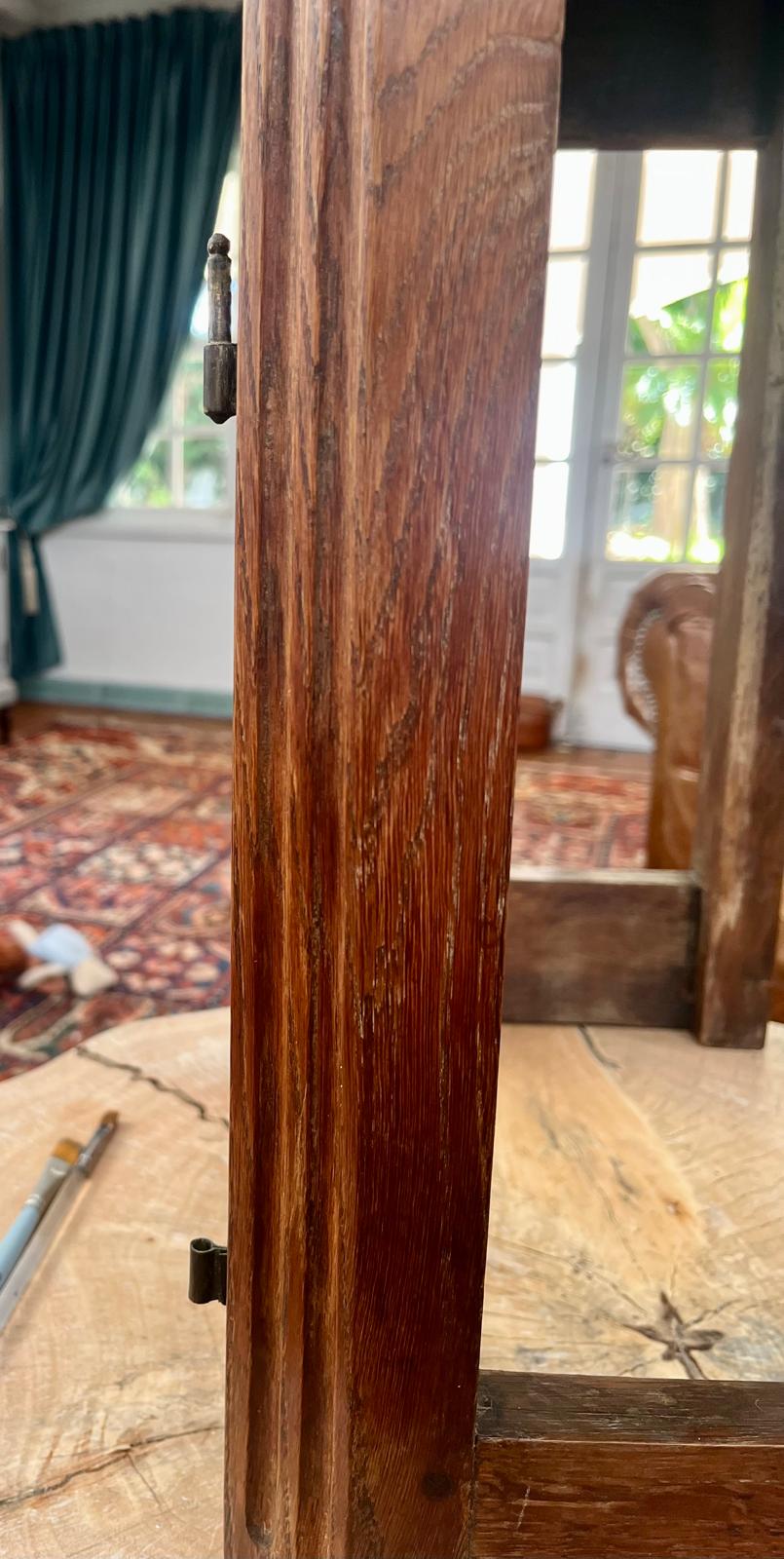
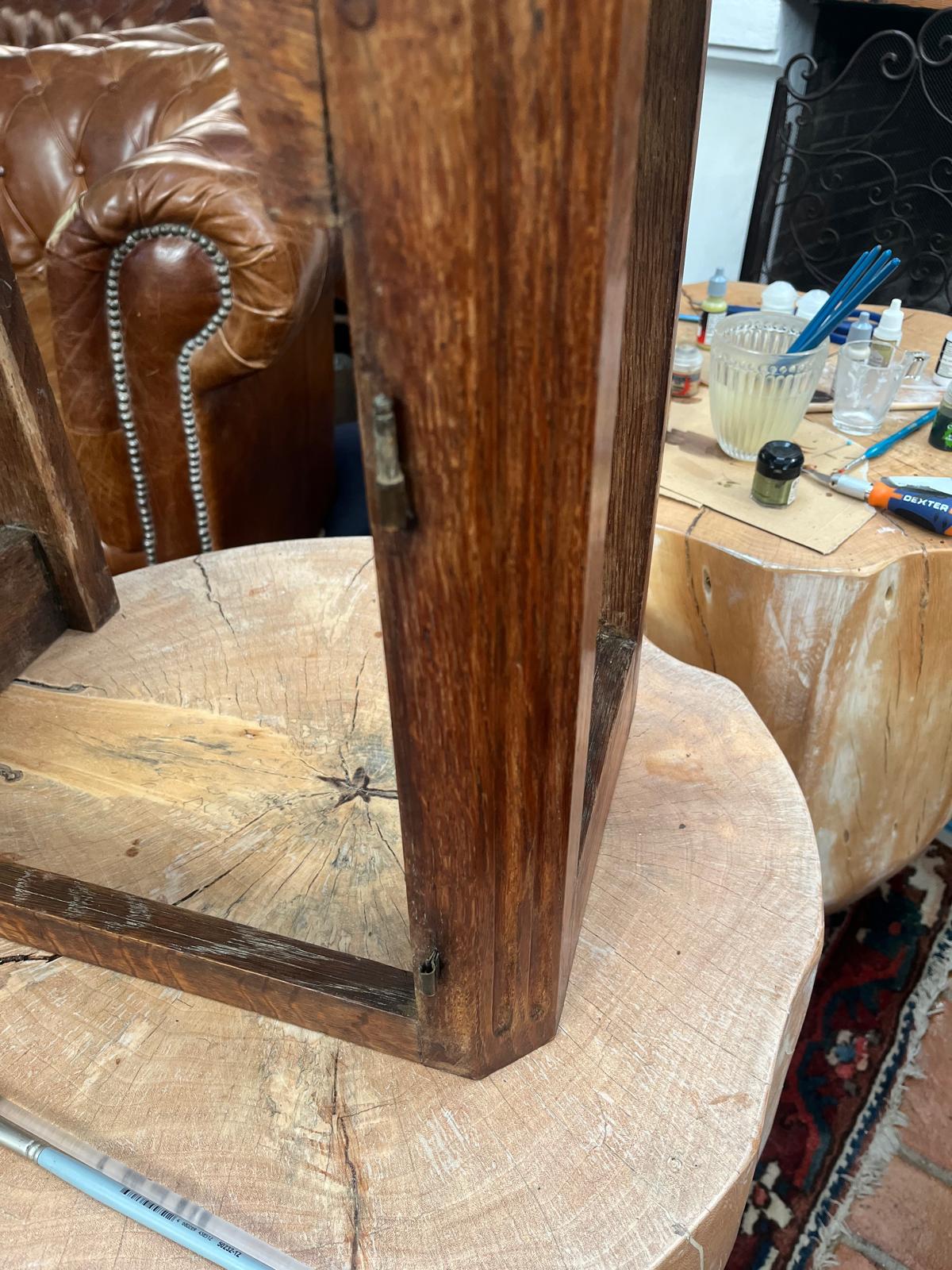
The pins (axes) of both hinges face strictly in one direction — straight up. The hinge is fully separable, made of two independent halves: a lower, blind sleeve (the “mother”) fixed with forged screws into the hood’s frame, and an upper wing with a built-in steel pin (the “father”) set into the door.
The uniqueness of the Baroque fit lies in the complete absence of visible gaps. The hood frame’s construction overhangs the door with a dense walnut molding, fully blocking any free vertical travel. Trying to simply lift the door straight up causes it to jam instantly.
Taking the hinge apart requires knowing a precise, jeweler-grade spatial micro-clearance:
- The hood’s door is opened to one strictly defined, calibrated angle, at which its top edge clears the overhanging cornice.
- The leaf is then eased forward, “toward you,” exactly along the vector the pins travel on.
- A light lift then frees the pins from their sockets, letting the door come off completely — no screwdrivers, no force tools.
The knock-down flag-hinge mechanism of the 18th century represents the highest standard of practical Baroque engineering. The old masters understood that a clock’s brass “brain” needs regular upkeep — servicing the going train, replacing drum cords, washing the finest blown glass. Building a separable hinge fully protected the soft black-walnut wood from being barbarically unscrewed over and over, keeping the mounting sockets sound for centuries.