21 September 2026
Geometry of SpaceThe Secret Code of the Lantern
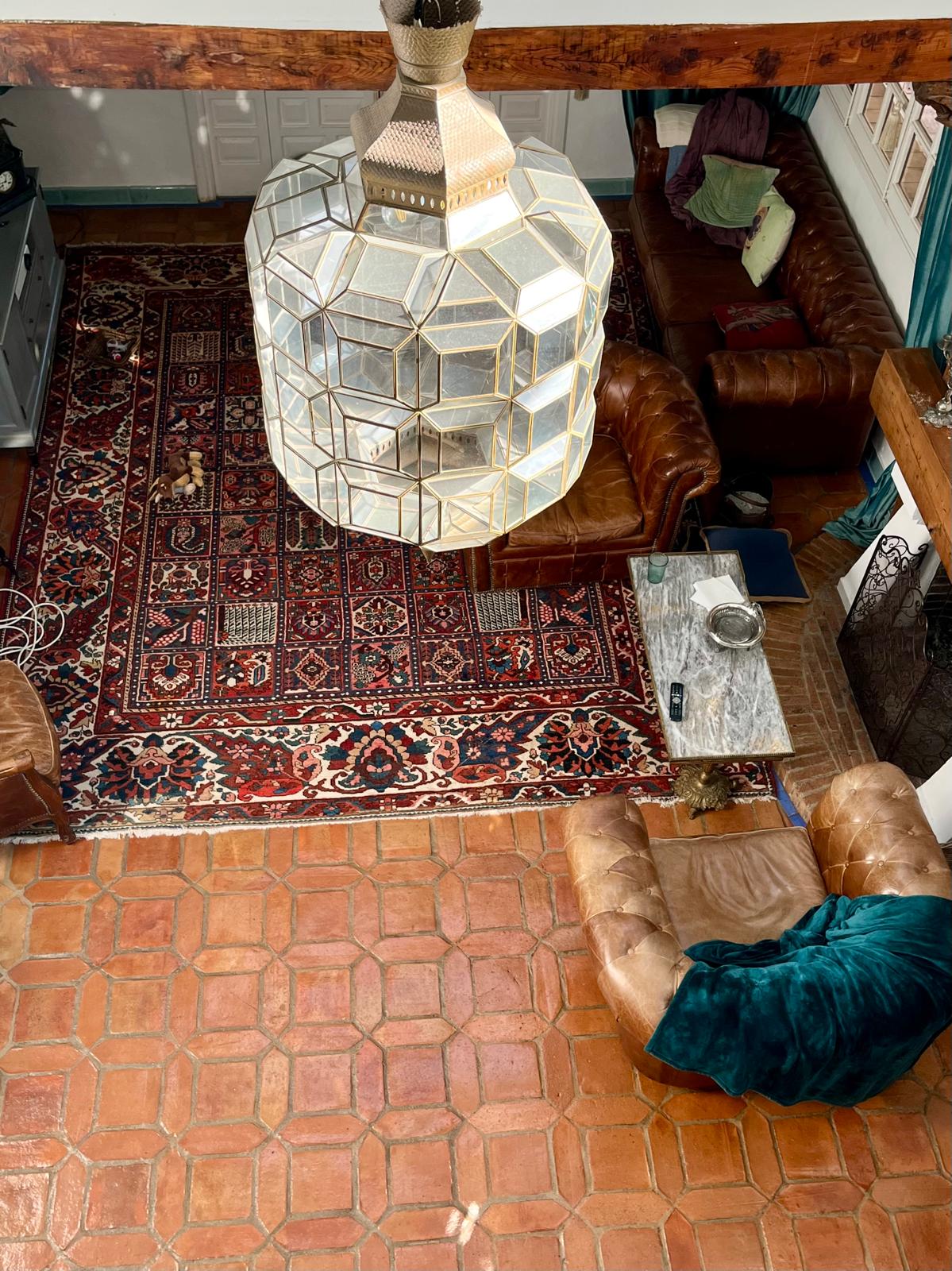
The Secret Code of the Lantern
Sometimes a Home needs many years, and one attentive, trained eye, to lay bare its true harmony. Objects and surfaces know how to wait for a person capable of reading their hidden connections and silent dialogues.
For years, this living room’s previous owners walked over the antique terracotta tile without ever suspecting what secret it held. The floor had been sealed solid under a thick layer of traditional black Spanish wax (cera), which turned the noble clay masonry into a dull, unreadable dark mass. The floor’s pattern didn’t exist for the eye — it lay buried under a patina of time and tradition.
But once the black wax was carefully stripped away and the terracotta regained its original warm color, the living room’s whole space instantly reorganized itself. Its entire tectonics shifted.
An eye trained on the strict laws of academic composition and visual rhyme immediately noticed what previous inhabitants had failed to see for decades. The ancient floor masonry is woven from flawless octagons, joined at their corners by carved square insets. And this intricate baroque pattern replicates, down to the millimeter, the geometry of the interior’s true star — the enormous brass El Farol lantern, hovering beneath the ceiling beams.
The facets of the lantern’s glass dome and the seams of its brass panels drop straight down along perfect, invisible axes, threading the tile’s pattern onto themselves. The circle closes, and chaos gives way to absolute mathematical harmony.
Chance objects, gathered from different eras and countries — from massive leather chesterfields to the baroque gilded mirror by the fireplace — gained a rigorous, reliable architectural framework. The floor holds up the ceiling; the lantern mirrors the ground. Once again, the Home proved that its geometry was decided long before the key first turned in its door.